
-
×
 Reading Biblical Literature: Genesis to Revelation By Craig Koester
1 × $5,00
Reading Biblical Literature: Genesis to Revelation By Craig Koester
1 × $5,00 -
×
 Healthy Pregnancy, Healthy Baby By Jill Miller
1 × $5,00
Healthy Pregnancy, Healthy Baby By Jill Miller
1 × $5,00 -
×
 NXT Level FX By Investors Domain
1 × $5,00
NXT Level FX By Investors Domain
1 × $5,00 -
×
 The Federal Code Blueprint 2023 2.0 By Jason White
1 × $23,00
The Federal Code Blueprint 2023 2.0 By Jason White
1 × $23,00 -
×
 Evidence-Based Treatment Planning for Obsessive Compulsive Disorder with Timothy Bruce & Arthur Jongsma
1 × $8,00
Evidence-Based Treatment Planning for Obsessive Compulsive Disorder with Timothy Bruce & Arthur Jongsma
1 × $8,00 -
×
 Build A Print-On-Demand Empire By Adrian Morrison
1 × $5,00
Build A Print-On-Demand Empire By Adrian Morrison
1 × $5,00 -
×
 Hypno Sexual Tool Box for Men By Victoria Gallagher - Hyptalk
1 × $33,00
Hypno Sexual Tool Box for Men By Victoria Gallagher - Hyptalk
1 × $33,00 -
×
 Weightless Wealth By Elisa Canali
1 × $31,00
Weightless Wealth By Elisa Canali
1 × $31,00 -
×
 HOODRICH CREDIT MENTORSHIP
1 × $39,00
HOODRICH CREDIT MENTORSHIP
1 × $39,00 -
×
 Fort Worth Playboy Evergreen VIP Bundle
1 × $69,00
Fort Worth Playboy Evergreen VIP Bundle
1 × $69,00 -
×
 The Quantum Angels Program by Burt Goldman
1 × $6,00
The Quantum Angels Program by Burt Goldman
1 × $6,00 -
×
 Buying A Profitable Revenue Stream And Call By Bruce Whipple
1 × $31,00
Buying A Profitable Revenue Stream And Call By Bruce Whipple
1 × $31,00 -
×
 Understanding the DSM-5 by Karen Phillip & Wayne Phillip
1 × $31,00
Understanding the DSM-5 by Karen Phillip & Wayne Phillip
1 × $31,00 -
×
 The Trading Blueprint By Brad Goh - The Trading Geek
1 × $5,00
The Trading Blueprint By Brad Goh - The Trading Geek
1 × $5,00 -
×
 ESG Disclosure By Derek Young - CFI Education
1 × $15,00
ESG Disclosure By Derek Young - CFI Education
1 × $15,00 -
×
 The Irish Identity: Independence, History, and Literature By Marc Conner
1 × $5,00
The Irish Identity: Independence, History, and Literature By Marc Conner
1 × $5,00 -
×
 The Ultimate Project Finance Modeling Package By Kyle Chaning Pearce - Wall Street Prep
1 × $69,00
The Ultimate Project Finance Modeling Package By Kyle Chaning Pearce - Wall Street Prep
1 × $69,00 -
×
 Messaging Program By Phoebe Kuhn - The Content Emporium
1 × $209,00
Messaging Program By Phoebe Kuhn - The Content Emporium
1 × $209,00 -
×
 Buddhism By Malcolm David Eckel
1 × $5,00
Buddhism By Malcolm David Eckel
1 × $5,00 -
×
 Master Emotions By Stone River eLearning
1 × $23,00
Master Emotions By Stone River eLearning
1 × $23,00 -
×
 School of Cinematic Motion Design - Mastery by Motion Science
1 × $39,00
School of Cinematic Motion Design - Mastery by Motion Science
1 × $39,00 -
×
 Set Your Income Goals and Develop a Revenue Strategy By Megan Auman
1 × $5,00
Set Your Income Goals and Develop a Revenue Strategy By Megan Auman
1 × $5,00 -
×
 Inner Evolution by Bruce Lipton
1 × $5,00
Inner Evolution by Bruce Lipton
1 × $5,00 -
×
 REELS ACADEMY By Anneke Odendaal - Pink Sparrow Social
1 × $279,00
REELS ACADEMY By Anneke Odendaal - Pink Sparrow Social
1 × $279,00 -
×
 The Midyear Money Upgrade by Victoria Washington
1 × $22,00
The Midyear Money Upgrade by Victoria Washington
1 × $22,00 -
×
 Turning Points in Middle Eastern History By Eamonn Gearon
1 × $5,00
Turning Points in Middle Eastern History By Eamonn Gearon
1 × $5,00 -
×
 How to Ease Damaging Patterns of Jealousy and Envy By NICABM
1 × $39,00
How to Ease Damaging Patterns of Jealousy and Envy By NICABM
1 × $39,00 -
×
 TikTok Ads Mastery 2024 By Chase Chappell
1 × $23,00
TikTok Ads Mastery 2024 By Chase Chappell
1 × $23,00 -
×
 30 Days of Alignment By Roxy Lee
1 × $15,00
30 Days of Alignment By Roxy Lee
1 × $15,00 -
×
 Yes Supply Method 2022 - Become a Life Coach, Manifestation Coach and Get Your NLP Certification By Reese Evans - Yes Supply
1 × $124,00
Yes Supply Method 2022 - Become a Life Coach, Manifestation Coach and Get Your NLP Certification By Reese Evans - Yes Supply
1 × $124,00 -
×
 Black Ops Underground Hypnosis by Taylor Starr
1 × $5,00
Black Ops Underground Hypnosis by Taylor Starr
1 × $5,00 -
×
 Champion Baller Pimp and The Six System By Brandon Carter
1 × $8,00
Champion Baller Pimp and The Six System By Brandon Carter
1 × $8,00 -
×
 Capital Club Academy
1 × $31,00
Capital Club Academy
1 × $31,00 -
×
 Orgasmic And Erotic Hypnosis Course 2023 By David Mears
1 × $186,00
Orgasmic And Erotic Hypnosis Course 2023 By David Mears
1 × $186,00 -
×
 The Apocryphal Jesus By David Brakke
1 × $5,00
The Apocryphal Jesus By David Brakke
1 × $5,00 -
×
 4 Product Bundle By Allie Bloyd
1 × $39,00
4 Product Bundle By Allie Bloyd
1 × $39,00 -
×
 The SMMA Academy Plus 2023 By Sander Stage
1 × $23,00
The SMMA Academy Plus 2023 By Sander Stage
1 × $23,00 -
×
 This Day in History: September By Wondrium
1 × $5,00
This Day in History: September By Wondrium
1 × $5,00 -
×
 The World Was Never the Same: Events That Changed History By Rufus Fears
1 × $5,00
The World Was Never the Same: Events That Changed History By Rufus Fears
1 × $5,00 -
×
 How I use Technical Analysis And Orderflow By Adam Webb - Traderskew
1 × $54,00
How I use Technical Analysis And Orderflow By Adam Webb - Traderskew
1 × $54,00 -
×
 Beginner Forex Mastery Course By Harrison Uwah - MHU FX Academy
1 × $78,00
Beginner Forex Mastery Course By Harrison Uwah - MHU FX Academy
1 × $78,00 -
×
 Mathematical Decision Making: Predictive Models and Optimization By Scott Stevens
1 × $5,00
Mathematical Decision Making: Predictive Models and Optimization By Scott Stevens
1 × $5,00 -
×
 The Great Tours: Ireland and Northern Ireland By Marc Conner
1 × $5,00
The Great Tours: Ireland and Northern Ireland By Marc Conner
1 × $5,00 -
×
 The Be More Persuasive Hypnosis 5-Pack By Uncommon Knowledge
1 × $15,00
The Be More Persuasive Hypnosis 5-Pack By Uncommon Knowledge
1 × $15,00 -
×
 The Great Tours: France through the Ages By John Greene
1 × $5,00
The Great Tours: France through the Ages By John Greene
1 × $5,00



The History of Christianity II: From the Reformation to the Modern Megachurch By Molly Worthen
$5,00
Exploring The History of Christianity II: From the Reformation to the Modern Megachurch – Digital Download!
Let’s embark on a captivating adventure to uncover remarkable insights that spark your curiosity and elevate your understanding
The History of Christianity II: From the Reformation to the Modern Megachurch By Molly Worthen
Overview
Exploring The History of Christianity II: From the Reformation to the Modern Megachurch
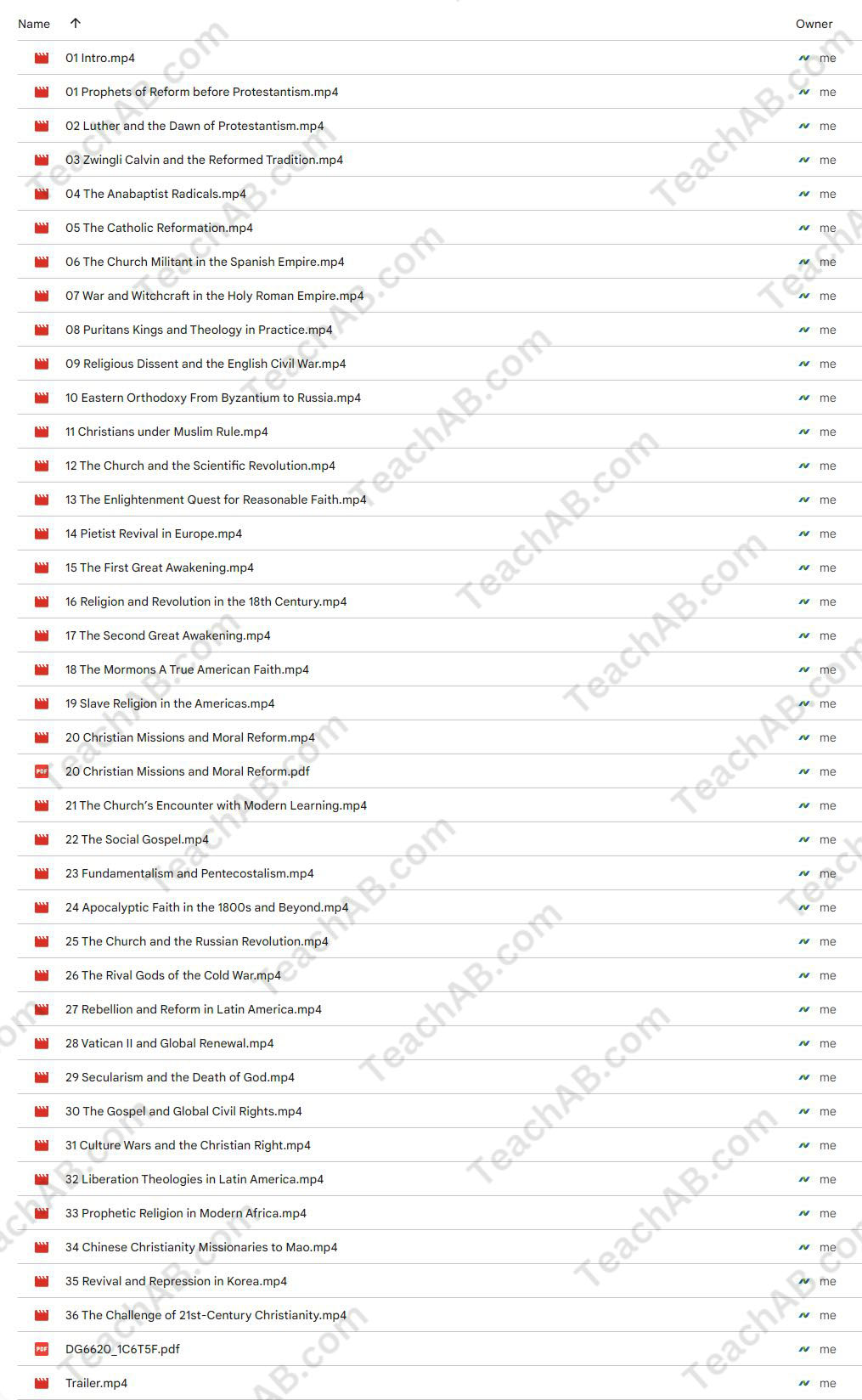
The narrative of Christianity is one of constant evolution, reflecting society’s own changes and conflicts. In Molly Worthen’s illuminating course, The History of Christianity II: From the Reformation to the Modern Megachurch, we embark on a transformative journey through more than 500 years of Christian history, from Martin Luther’s audacious 95 theses to the rise of modern megachurches. This series is not merely a chronological list of events, but a richly woven tapestry that intertwines theology with societal shifts, offering a profound understanding of Christianity’s complexities and its role in shaping world history. Worthen masterfully presents historical insights alongside individual narratives, enabling us to appreciate the faith’s evolution in a more personal and relatable context.
The Seeds of Reformation: Understanding the 95 Theses
The Spark of Change
The course begins with one of the most pivotal moments in Christian history Martin Luther’s 95 theses posted in 1517. These theses were not merely criticisms of the Catholic Church’s practices; they symbolized a groundswell of dissatisfaction with the church’s corruptions and the hypocrisy of selling indulgences. The act itself serves as a metaphor, igniting a flame that would lead to the vast wilderness of religious diversity. It prompted reformers such as Huldrych Zwingli and John Calvin to voice their theological perspectives, each contributing to a dynamic reformation landscape.
Luther’s work set off a revolution that spiraled into movements which challenged the monolithic structure of the Church. For instance, Calvin introduced the idea of predestination, a doctrine that would resonate powerfully in both Europe and America. The spirit of reform spread, leading to the establishment of various denominations and radically redefined relationships with scripture. Worthen emphasizes how Luther’s theological assertions not only questioned the papal authority but also democratized access to the Bible, thus stimulating individual interpretations.
Key Figures of the Reformation
Influential Reformers
- Martin Luther: Challenged Church corruption and emphasized justification by faith.
- John Calvin: Advanced the concept of predestination and founded Calvinism.
- Huldrych Zwingli: Pioneered reforms in Zürich, emphasizing a return to the Scriptures.
- Anabaptists: Advocated for adult baptism and a separation of church and state.
These figures were like composers of a grand symphony, where each added their unique melody, creating a harmonious yet discordant new world of beliefs.
The Catholic Reformation
As the Protestant Reformation gained momentum, the Catholic Church was compelled to respond. The Catholic Reformation, also known as the Counter-Reformation, aimed to address internal issues while reaffirming the Church’s core doctrines. The Council of Trent (1545-1563) marked a crucial moment in this period, where Catholic leaders sought to stem the tide of reformist sentiments. This council redefined the theological underpinnings of the Church and re-established practices intended to curb the abuses that had initially sparked the Reformation.
Through her storytelling technique, Worthen highlights personal stories from this era, illustrating the human experiences entwined with dogma and conflict. These accounts breathe life into historical facts, allowing us to empathize with those navigating the turbulent seas of change. The clash of ideologies signifies not just a schism in beliefs but a profound transformation of cultural identities across Europe.
The Emergence of Denominations: A Global Spectrum of Faith
Diverse Beliefs
As Christianity evolved, various denominations emerged, each representing distinct interpretations of doctrine and practice. Worthen meticulously details how the Protestant Reformation engendered a spectrum of beliefs, from Lutheranism to Anglicanism, Baptism, and Methodism, each carving out its unique identity. These varied approaches to faith can be likened to branches sprouting from a single tree, each growing in directions unique to its environment.
In this regard, Worthen presents a poignant analysis of the implications of such diversity. The fragmentation of the faith reflects humanity’s needs for different expressions of spirituality, leading to a blossoming of religious thought. As new denominations emerged, they often brought with them specific cultural practices and social implications, representing a resolve to address community needs and individual spiritual quests.
Global Impact
The prominence of the new denominations was not confined to Europe. As Christianity spread across oceans to the Americas, it encountered indigenous cultures and varied socio-political landscapes. The narratives that Worthen weaves here illustrate the tension between colonization and mission work, heightening the ethical dilemmas faced by believers. Christianity became both a tool of empire and a means of empowerment for marginalized populations.
Key Denominations and Their Characteristics
| Denomination | Key Beliefs | Founding Figures |
| Lutheranism | Justification by faith | Martin Luther |
| Calvinism | Predestination | John Calvin |
| Anabaptism | Adult baptism, non-violence | Menno Simons |
| Anglicanism | Via Media (Middle Way) | Henry VIII |
| Methodism | Free will, social holiness | John and Charles Wesley |
The dynamic histories of these denominations sharpen our understanding of how Christianity molded cultural identities, and how these identities, in turn, shaped the expressions of faith.
Christian Response to Secularism and Modernity
Navigating Contemporary Challenges
As Worthen transitions to modern times, the focus turns to the lifeline between faith and increasingly secular societies. The relationship between Christianity and capitalism emerges, painting a complex picture of the commercialization of faith and how it sometimes conflicts with core Christian values. This juxtaposition can be likened to a tightrope walk, with believers seeking to balance their spiritual convictions against the demands of a materialistic world.
With the rise of megachurches in the late 20th century, Worthen illustrates how these new forms of worship reflect broader cultural trends. Megachurches, often characterized by their large congregations and multimedia-driven services, have redefined community engagement. The idea of the megachurch can evoke mixed feelings; for some, it symbolizes the vibrant adaptability of faith to contemporary needs, while for others, it raises questions about authenticity and commercialization.
Interfaith Dialogue
The course also addresses the significant role of interfaith dialogue in today’s context. In an increasingly globalized world, the importance of fostering understanding between different faith traditions is vital. Worthen notably discusses how Christianity intersects with other faiths, echoing the broader cultural shifts influenced by migration, globalization, and the digital age. The emphasis on inclusive dialogues showcases a progressive step toward bridging divides that can lead to mutual respect and understanding among diverse belief systems.
Challenges Facing Modern Christianity
- Secularism: Declining church attendance and the rise of non-religious identities.
- Materialism: The tension between faith and consumerism.
- Technological Change: Adapting to digital ministry and online engagement.
- Interfaith Relations: Navigating dialogues with other religious traditions.
Through these discussions, Worthen challenges her audience to explore not only the historical context but also the ongoing implications of these struggles within faith communities.
The Takeaway: Engaging with the Present through the Lens of History
A Comprehensive Journey
Molly Worthen’s comprehensive approach to the history of Christianity shines through the course, showcasing not only the significant theological shifts but also the socio-political ramifications of these changes. By presenting a multitude of perspectives, she creates a mosaic of beliefs that interact dynamically, reminding us that faith is both personal and communal.
Worthen’s work encourages listeners to engage critically with the past, fostering an understanding that in examining history, we glean wisdom for the present. The interplay between faith and societal changes revealed in this course invites individuals to reflect on their beliefs and the contexts within which they strive to express their spirituality.
Reflection on Faith and Practice
Ultimately, The History of Christianity II serves as more than just a historical exploration; it is an invitation to ponder how the lessons from the past inform our current faith practices. In a world of increasing division and complexity, engaging with our Christian heritage allows us to navigate the contemporary landscape with greater insight and a sense of purpose.
In conclusion, Worthen’s course is a significant contribution to understanding not only the trajectory of Christianity but also its vital place in today’s world. We are challenged to consider how this historical tapestry of beliefs shapes our interactions and response to the pressing issues of our time. As we reflect on the evolution of Christianity, we might find that its history echoes in our everyday lives, urging us toward a deeper engagement with both our faith and our world.
Frequently Asked Questions:
Innovation in Business Models: We use a group purchase approach that enables users to split expenses and get discounted access to well-liked courses. Despite worries regarding distribution strategies from content creators, this strategy helps people with low incomes.
Legal Aspects to Take into Account: Our operations’ legality entails several intricate considerations. There are no explicit resale restrictions mentioned at the time of purchase, even though we do not have the course developers’ express consent to redistribute their content. This uncertainty gives us the chance to offer reasonably priced instructional materials.
Quality Control: We make certain that every course resource we buy is the exact same as what the authors themselves provide. It’s crucial to realize, nevertheless, that we are not authorized suppliers. Therefore, the following are not included in our offerings: – Live coaching sessions or calls with the course author.
– Entry to groups or portals that are only available to authors.
– Participation in closed forums.
– Straightforward email assistance from the writer or their group.
Our goal is to lower the barrier to education by providing these courses on our own, without the official channels’ premium services. We value your comprehension of our distinct methodology.
Be the first to review “The History of Christianity II: From the Reformation to the Modern Megachurch By Molly Worthen”
You must be logged in to post a review.
Related products
Science
$5,00

$5,00
Science
$5,00
$5,00

$5,00

$5,00



Reviews
There are no reviews yet.