
 Family Systems Therapy with Kenneth Hardy
  Great Mythologies of the World By Grant Voth, Kathryn McClymond, Julius Bailey & Robert Andre LaFleur
The Neuroscience of Everyday Life By Sam Wang
$5,00
The neuroscience of everyday life – Digital Download!
Let’s embark on a captivating adventure to uncover remarkable insights that spark your curiosity and elevate your understanding
The Neuroscience of Everyday Life By Sam Wang
Overview
The neuroscience of everyday life
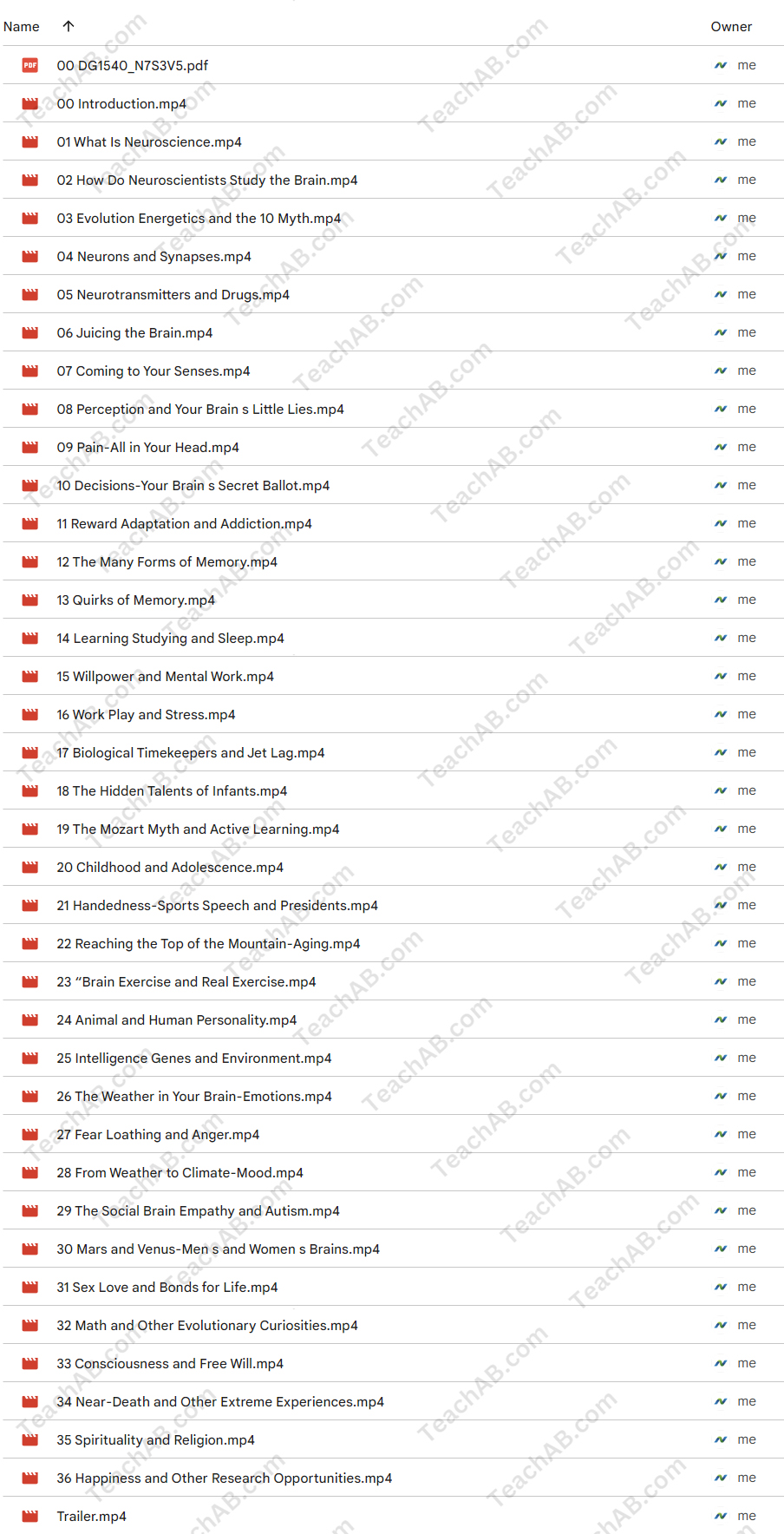
Understanding the intricate workings of our brains can feel like peeling away the layers of an onion, each layer revealing a new dimension of insight into how we behave, think, and experience life. Sam Wang, a distinguished neuroscientist and professor at Princeton University, invites us on a fascinating journey through “The Neuroscience of Everyday Life.” This course, comprising 36 lectures, is far more than an academic exercise; it’s a vibrant exploration of the neurological foundations that underpin our daily experiences. Wang’s approach is refreshingly accessible. He distills complex neuroscientific concepts into digestible pieces, making the intricate mechanisms of the brain relatable even to those without a background in science.
In this detailed review, we will dissect the various components that make this course exceptional, from Wang’s engaging teaching style to the practical insights he offers. With a combination of humor, clarity, and evidence-based insights, “The Neuroscience of Everyday Life” explores critical topics like memory, decision-making, and emotional health, all while debunking common myths about the brain. By integrating neuroscience with everyday experience, Wang provides a roadmap for understanding ourselves that is both enlightening and engaging.
Engaging Teaching Style
Humor and Clarity
Sam Wang’s teaching style stands out as an invaluable aspect of “The Neuroscience of Everyday Life.” Through a combination of humor and clarity, he expertly navigates complex topics, making them accessible to everyone. Imagine attending a lecture where instead of dry, academic jargon, the presenter uses relatable anecdotes or humorous metaphors that mirror everyday experiences. For instance, when discussing memory, he might liken the brain’s ability to recall information to a cluttered attic, where memories can get lost among various items. Such metaphors not only clarify concepts but also stick in our memory, a testament to Wang’s teaching acumen.
Thought-Provoking Concepts
Wang dives deep into thought-provoking concepts, such as the dual nature of memory. He explores how certain memories can fade or be reconstructed over time. This aspect resonates with many, as we often wrestle with fragmented recollections of significant events in our lives. Wang’s ability to explain the cognitive mechanisms that underlie these processes provides a richer understanding of our emotional landscapes. His lessons make us question our own understanding of memory, pushing us to consider how our life narratives are continuously shaped and reshaped by our recall.
Accessibility for All
What truly makes this course remarkable is its accessibility. Wang frames his lectures to resonate with a broad audience. His style invites curiosity rather than intimidation, debunking the notion that neuroscience is only for those with extensive scientific backgrounds. He often poses rhetorical questions to stimulate critical thinking, compelling us to engage actively with the material rather than passively absorb facts. This pedagogical approach isn’t merely academic; it is designed to spark a love for learning about the brain, fostering a community of inquisitive minds eager to understand the complex workings within their heads.
Unpacking Critical Topics
Memory
One of the pivotal topics in “The Neuroscience of Everyday Life” is memory. Wang highlights the complexity and malleability of our memories. He discusses the two types of memory: explicit (declarative) and implicit (non-declarative). Explicit memory is akin to a library where we can pull out specific books of information, while implicit memory functions more like muscle memory, guiding our actions without our conscious awareness. Wang’s exploration of these concepts is not merely academic; he provides real-world examples that demonstrate how our memories can be altered, such as through expectations and social influences.
A Comparative Perspective on Memory Types
- Explicit Memory
- Definition: Conscious recall of facts and events.
- Examples: Facts for an exam, remembering a face.
- Implicit Memory
- Definition: Unconscious memory that influences behavior.
- Examples: Riding a bike, typing on a keyboard.
Decision-making
Wang also delves into decision-making processes, revealing that our brains are constantly processing information and making choices often before we are consciously aware of them. Imagine standing before a crossroads without realizing your brain has already evaluated potential paths based on previous experiences and emotions. This subconscious decision-making process can explain why sometimes our “gut feelings” lead us in a particular direction, acting as an internal compass shaped by neural pathways. Wang highlights research that illustrates the brain’s incredible capacity to weigh multiple scenarios rapidly.
Key Factors in Decision-Making
- Emotional Influences
- Our emotions can significantly impact our choices.
- Decisions often combine rational thought with feelings.
- Cognitive Biases
- We fall prey to biases that can skew our decision-making process.
- Awareness of these issues can improve our choices.
Stress and Emotions
An equally enthralling discussion surrounds stress and emotions. Wang’s insights into how stress impacts both mental and physical health resonate deeply in today’s high-pressure environment. He elucidates the concept of the stress response, illustrating how our bodies react to perceived threats with the fight or flight response, priming us for survival. However, in a modern context, this response can lead to chronic stress, which adversely affects our cognitive functions and overall well-being.
Effects of Stress
- Cognitive Decline
- Prolonged stress can impair memory and decision-making.
- Physical Health
- Chronic stress has been linked to various health issues, including heart disease.
Debunking Myths
Common Misconceptions About the Brain
One particularly refreshing aspect of Wang’s teaching is his commitment to debunking common myths surrounding the brain. For example, the pervasive idea that we only use 10% of our brain’s capacity is confronted head-on. In reality, Wang presents evidence that our brains are always active, utilizing various regions depending on the task at hand. This notion serves to emphasize not just the capacity of the human brain but also its remarkable efficiency and adaptability.
Popular Myths Debunked
- Using Only 10% of Our Brain
- Truth: We use virtually all parts of our brain, albeit not all at once.
- Left-Brained vs. Right-Brained People
- Truth: Most people utilize both hemispheres for various tasks, not strictly artistic or analytical.
- Memory is Like a Video Recorder
- Truth: Memories can be reconstructed and are subject to distortion.
Practical Advice from Neuroscience
Enhancing Willpower
Moreover, Wang doesn’t just present theoretical knowledge; he provides practical exercises rooted in neuroscience. For instance, he suggests using one’s nondominant hand to perform tasks as a method to enhance willpower. This exercise stimulates neuroplasticity the brain’s ability to adapt and reorganize itself ultimately helping individuals gain greater control over their impulses and decisions.
Lifestyle Choices and Brain Health
Additionally, the course emphasizes the critical role of lifestyle choices in maintaining brain health. Wang correlates regular physical exercise with cognitive improvements, promoting a holistic view of mental and physical health. He describes studies that link even moderate exercise to enhanced memory and learning capabilities. Sleep, too, is explored as a fundamental pillar of cognitive health, with Wang detailing its vital role in consolidating memories and supporting emotional regulation.
Summary of Practical Advice
- Use Nondominant Hand
- Enhances neural connections and willpower.
- Regular Exercise
- Linked to improved cognitive function and mood.
- Prioritize Sleep
- Essential for memory consolidation and cognitive performance.
Ongoing Relevance vs. Advancements in Neuroscience
A Critical Reflection
While the course is widely recognized for its contributions to the understanding of neuroscience, some critics argue that certain content may appear outdated due to the rapid advancements in the field. However, this criticism does not overshadow the course’s ability to provide a solid introduction to various topics in neuroscience. The frameworks established by Wang are still relevant, fostering a deeper appreciation for the human brain’s complexities and preparing the audience to pursue further learning.
Lasting Impact of the Course
Wang’s lectures create a pathway for curious minds who may wish to dive deeper into the science of the brain. His coursework serves as a gateway, encouraging individuals to seek out new research and insights that continue to emerge within the field, ultimately enriching their understanding of both neuroscience and their daily lives.
Conclusion
In summary, “The Neuroscience of Everyday Life” by Sam Wang presents an engaging, insightful, and thorough exploration of how our brains shape daily experiences and behaviors. Wang’s ability to blend complex scientific concepts with humor and accessible teaching makes this course an invaluable resource for all who are curious about neuroscience. Whether you’re looking to enhance your understanding of memory, decision-making, emotions, or the impact of stress, this course provides a solid foundation from which to explore the depths of the human experience. Highly recommended for anyone interested in understanding the science that underpins their everyday lives, Wang’s course stands as a beacon of learning in the fascinating world of neuroscience.
Frequently Asked Questions:
Innovation in Business Models: We use a group purchase approach that enables users to split expenses and get discounted access to well-liked courses. Despite worries regarding distribution strategies from content creators, this strategy helps people with low incomes.
Legal Aspects to Take into Account: Our operations’ legality entails several intricate considerations. There are no explicit resale restrictions mentioned at the time of purchase, even though we do not have the course developers’ express consent to redistribute their content. This uncertainty gives us the chance to offer reasonably priced instructional materials.
Quality Control: We make certain that every course resource we buy is the exact same as what the authors themselves provide. It’s crucial to realize, nevertheless, that we are not authorized suppliers. Therefore, the following are not included in our offerings: – Live coaching sessions or calls with the course author.
– Entry to groups or portals that are only available to authors.
– Participation in closed forums.
– Straightforward email assistance from the writer or their group.
Our goal is to lower the barrier to education by providing these courses on our own, without the official channels’ premium services. We value your comprehension of our distinct methodology.
Be the first to review “The Neuroscience of Everyday Life By Sam Wang”
You must be logged in to post a review.
Related products




Science











Reviews
There are no reviews yet.